
Featured Artist: Tracy Tohannie
Updated: Aug 17
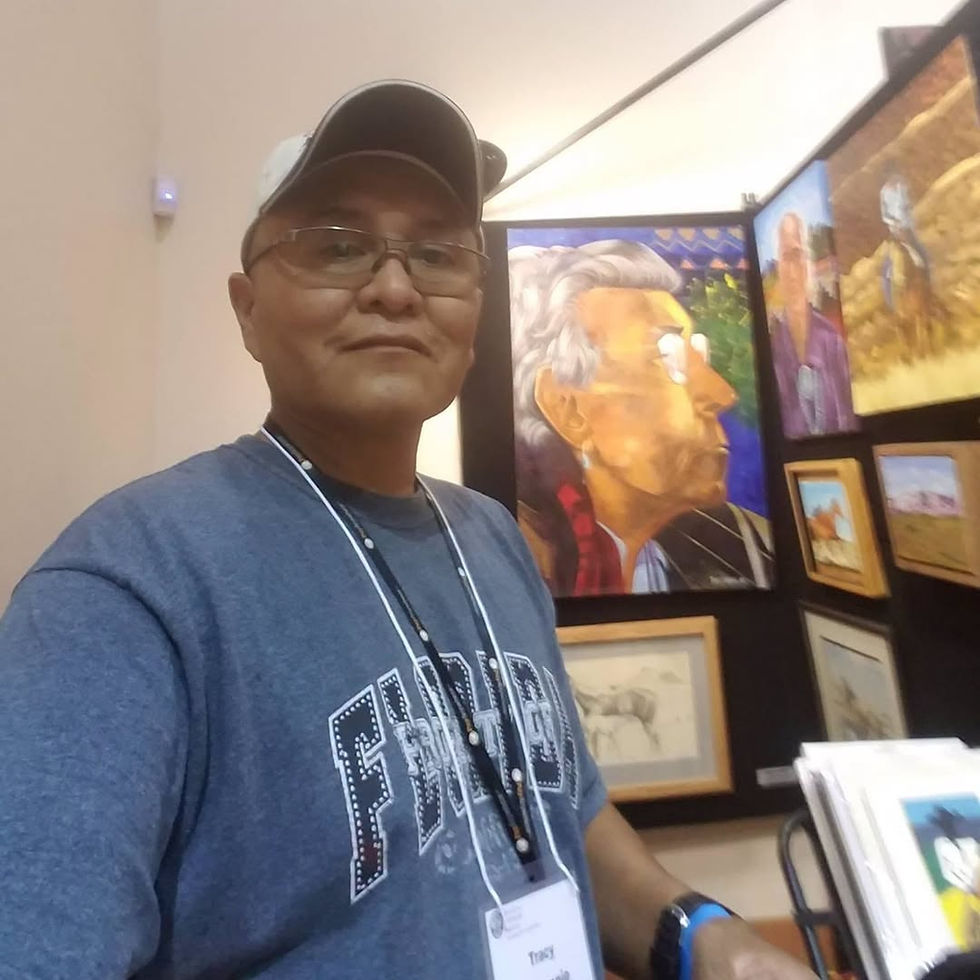
Diné painter and botanist Tracy Tohannie brings horses, family life, everyday activity, and the landscapes of northern Arizona together through vivid color, expressive lines, and energetic brushstrokes. At the center of his work is Beauty Way, a Diné teaching that Tohannie connects with harmony, happiness, good health, compassion, respect, and appreciation for life.
Tohannie’s paintings move between cultural teachings, personal memory, and close observation. Some capture horses racing across open land in brilliant orange, blue, purple, and yellow. Others portray quieter moments around a hogan, campfire, woodpile, or family home. Together, these works present Diné life not as something confined to the past, but as a living relationship among people, animals, family, community, and land.
From Childhood Drawing to a Life in Art
Tohannie was raised in Tonalea, a Diné community in northern Arizona. He traces his interest in art to childhood, when watching his older brothers draw inspired him to begin creating images of his own. As his artistic interests developed, he looked to Diné and Western artists including Redwing Nez, Bahe Whitethorne Sr., Elizabeth Whitethorne, Billy Whitethorne, Edward Whitethorne, Ray Swanson, Joe Beeler, and Norman Rockwell.
These influences introduced him to different approaches to observation, illustration, storytelling, composition, and movement. Tohannie eventually developed an artistic language distinguished by visible pencil marks, strong outlines, textured surfaces, contrasting colors, and expressive brushstrokes.
Although he works primarily with oil and acrylic paint, Tohannie does not restrict himself to a single medium. His paintings often begin with preliminary pencil sketches, but his broader practice also includes colored pencil, pen, ink, and occasional watercolor. The medium may change, but his attention to the emotional effects of color, line, texture, and contrast remains consistent.
That interest is immediately visible in his artwork. Rather than concealing every pencil line or brushstroke, Tohannie allows the process of making the image to remain visible. The marks give his paintings a sense of motion and physical energy while showing the artist’s hand within the finished work.
Horses, Family, and Contemporary Diné Life
Horses are among Tohannie’s most recognizable subjects. In some compositions, they are rendered with exaggerated color and surrounded by geometric forms, layered marks, and forceful outlines. In others, horses move through more naturalistic red sandstone canyons, sending dust into the air beneath expansive northern Arizona skies.
The horse paintings demonstrate the range of Tohannie’s visual approach. He can transform an animal into an almost abstract arrangement of color and movement, but he can also place horses within carefully observed landscapes that convey distance, atmosphere, and the physical character of the land.
His narrative paintings reveal another side of his work. A family scene may include children playing, an adult chopping wood, a pickup truck, dogs, livestock, household objects, and a hogan. These details matter because they connect cultural continuity with contemporary life. The paintings do not remove Diné people from the present or reduce their experiences to generalized images of tradition. Instead, they show family, work, play, vehicles, animals, homes, and cultural knowledge existing together.
Tohannie’s landscapes follow a similar approach. Mesas, vegetation, homesites, campfires, wagons, animals, and people become part of a shared environment rather than separate subjects. The land is not an empty background added behind the figures. It participates in the story and helps establish the relationships taking place within the painting.
Tracy Tohannie and Painting Beauty Way
Tohannie identifies Beauty Way as the central theme of his art. In his artist statement, he describes it as part of his Diné cultural heritage and connects it with positive behavior, courtesy, respect for oneself and others, and appreciation for all life. He presents Beauty Way alongside Protection or Warrior Way as teachings that help a person understand and respond to the different challenges and experiences of life.
This idea of contrasting forces is also reflected visually in his paintings. Brilliant colors appear beside darker passages. Carefully observed figures share space with expressive marks. Moments of calm coexist with running horses, rising dust, strong brushwork, and active family scenes. Tohannie has explained that his use of strong contrasts can symbolize this duality within his culture.
His choice of horses, people, homes, and landscapes is therefore more than a collection of familiar Southwestern subjects. These images allow him to explore the qualities he associates with Beauty Way, including harmony, compassion, happiness, health, resilience, and respect for life.
Tohannie also recognizes that viewers bring their own worries and experiences to a work of art. He has described his intention as creating paintings that can lighten a person’s burden and offer a moment of joy or peace. His work does not pretend that difficulty is absent from life. Instead, it considers how beauty, balance, family, movement, color, and connection can help people respond to it.
“I am very intrigued by the way color, texture and lines affect viewers when applied to canvas in a certain way.”— Tracy Tohannie
Art, Botany, and the Living Landscape
In addition to his work as an artist, Tohannie is a botanist with knowledge of the plant life of northern Arizona. The Museum of Indigenous People has identified him as both a painter and botanist, and Navajo YES has documented him sharing knowledge of local plants with community members.
These two areas of his life meet naturally in his attention to place. Desert vegetation, open skies, rock formations, homesites, animals, and human activity are all treated as interconnected parts of a living environment. Even when plants are not the primary subject, their presence helps establish the season, location, texture, and character of the landscape.
This relationship between artistic observation and knowledge of the natural world makes Tohannie’s work especially attentive to the places it represents. His landscapes are not generic ideas of the Southwest. They emerge from familiarity with northern Arizona and with the people, plants, animals, and communities that live there.
Experience Indigenous Artists at MIP
Native artist appearances at MIP present Indigenous art as a living and evolving practice. Visitors may have opportunities to meet artists, observe demonstrations, ask questions, and purchase original artwork directly from its creator. Tohannie’s participation reflects the museum’s continuing effort to create meaningful encounters between Indigenous artists and the public.
To learn about future appearances by Tracy Tohannie and other Native artists, visitors can explore upcoming events at MIP and subscribe to the museum’s monthly email newsletter. Readers can also contact the Museum of Indigenous People or ask a front desk volunteer to be added during their next museum visit.
Sources
Arizona Artist a Day: Tracy Tohannie’s Biography and Artist Statement
Museum of Indigenous People: Tracy Tohannie Guest Artist Appearance
Museum of Indigenous People: Tracy Tohannie Painting Demonstration
Museum of Indigenous People on Instagram: Featured Artist Tracy Tohannie
Museum of Indigenous People on Instagram: Tracy Tohannie Artist Appearance
Navajo YES: Botanist Tracy Tohannie Sharing Knowledge of Local Plants


