Tsidil: A Diné Stick Game of Story and Mathematics
Tsidil is a traditional Diné stick game that brings together oral history, movement, strategy, counting, and relationships with the natural world. Traditionally associated with women, the game may be played by women and men.
A Game Connected to Changing Woman
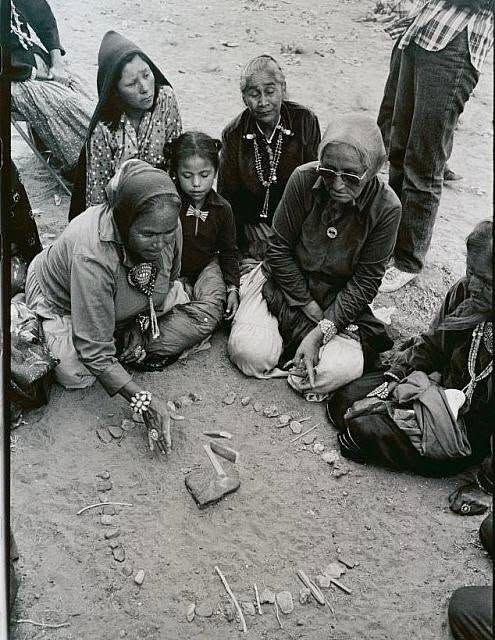
In the oral histories shared by Diné educator Renae K. Walters, Tsidil is connected to Changing Woman, Asdzą́ą́ Nádleehé. One account says Changing Woman created the game in the First World for women. Another describes Tsidil among the gifts and teachings she gave the Diné people as they prepared to travel to a new home.
Walters explains that several accounts of the game’s beginning have been carried through Diné oral tradition and may be understood as equally valid. Tsidil is commonly played during the winter, although teachings and seasonal practices may vary among families and communities across the Navajo Nation.
Meaning Within the Game
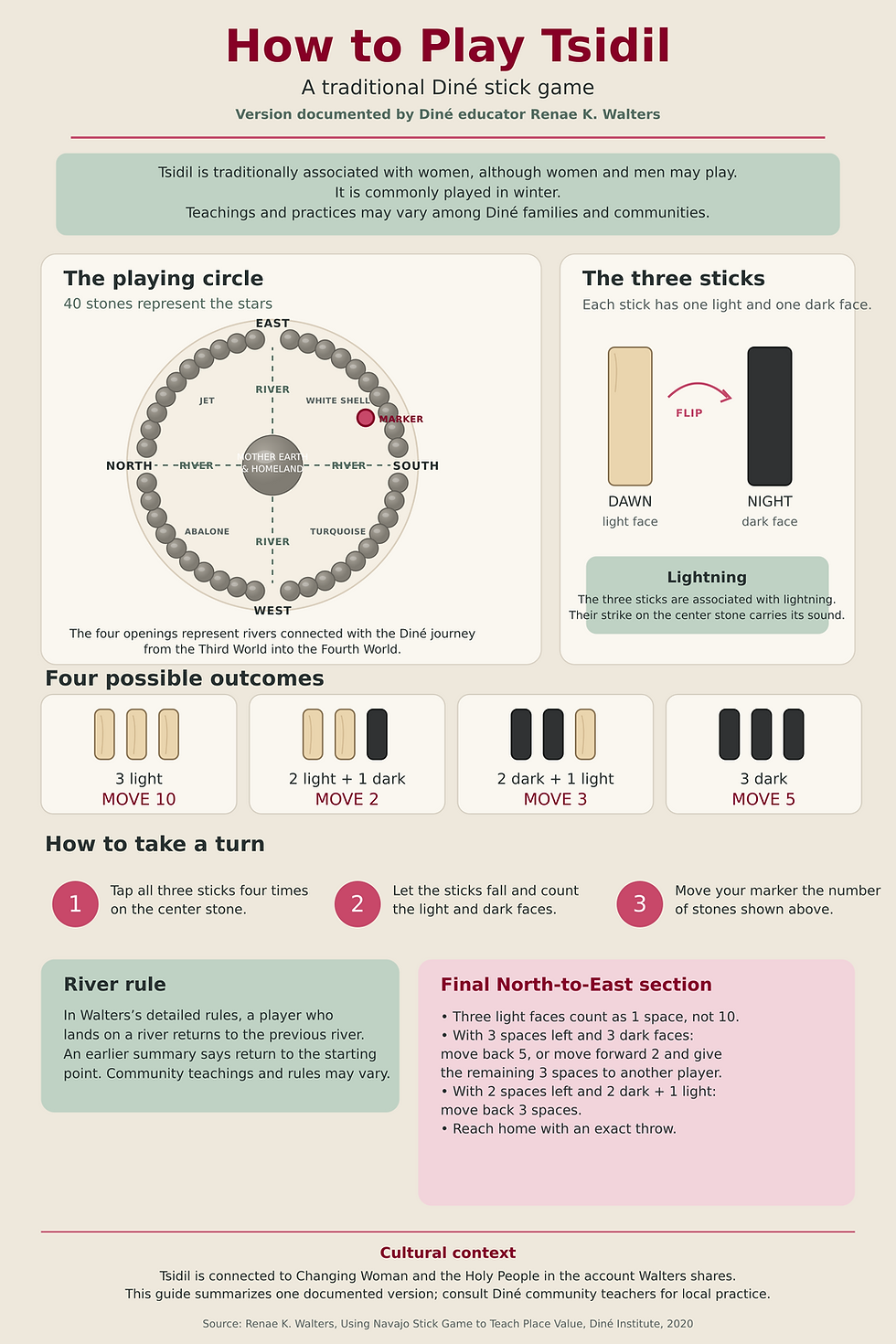
Tsidil is played with three sticks that are dark on one side and light on the other. The dark side represents night, while the light side is associated with day or dawn. Together, the three sticks are connected with lightning.
Forty smaller stones form the playing circle in four groups of ten. The stones represent the stars, while a larger stone at the center represents Mother Earth and the homeland. The four openings between the groups represent rivers connected to the Diné journey from the Third World into the Fourth World.
Players tap the sticks against the center stone before letting them fall. The sound of the sticks striking the stone represents lightning meeting the earth, while the combination of light and dark sides determines how far a player moves around the circle.
Walters’s curriculum gives two descriptions of what happens when a player reaches a river. An introductory passage says the player returns to the starting point, while the detailed instructions say the player returns to the previous river. This difference is important because Tsidil teachings and rules may vary among Diné communities. The version being played should be attributed to the family, community, or educator sharing it rather than presented as the only version of the game.
Bringing Tsidil Into the Classroom
Renae K. Walters was a third-grade teacher at Tonalea School in Tonalea, Tó Nehelį́į́h, when she developed Using Navajo Stick Game to Teach Place Value through the Diné Institute for Navajo Nation Educators.
Walters begins by teaching students the game’s oral history, materials, meanings, and established rules. Students play Tsidil before any part of it is adapted for mathematics, and families help children gather materials and participate from home.
Once students understand the game, Walters changes the numerical value assigned to each stone. The movement around the circle then helps students explore place value, rounding, addition, and subtraction. The mathematics is already present in the groups of ten, the values created by the sticks, the movement between positions, and the decisions players make throughout the game.
Walters’s curriculum shows how Diné cultural knowledge can remain connected to family and community while supporting new generations of learners. Tsidil continues to carry stories, relationships, and knowledge forward through play.
Learn More
Read Renae K. Walters’s complete curriculum, including the oral histories, playing instructions, Diné cultural standards, and mathematics lessons: