
Chaco Canyon to Lose Its Federal Protections?
Updated: Aug 31
Public Comment Deadline: July 29, 2026
The Bureau of Land Management is accepting comments on whether to keep, reduce, or revoke the current protections surrounding Chaco Culture National Historical Park.
Comments must be submitted by July 29, 2026, at midnight Mountain Daylight Time.
The most effective comments identify missing information, factual errors, local or cultural knowledge, analytical gaps, reasonable alternatives, mitigation measures, or credible sources the BLM should consider.
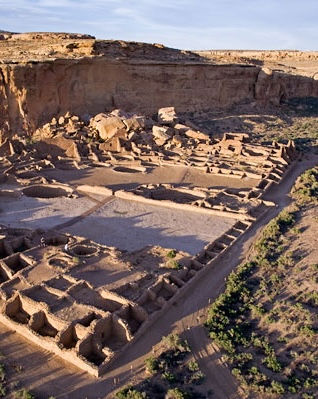
For Pueblo and Tribal communities, Chaco is not confined to the walls of a national historical park. The greater landscape includes ancestral roads, communities, ceremonial places, cultural resources, and relationships that extend far beyond the park boundary. These connections did not end when the structures now protected by the National Park Service were no longer occupied in the same ways. Chaco remains a living cultural landscape tied to the histories, identities, and responsibilities of Indigenous peoples today.
In June 2023, the Department of the Interior established a 20 year mineral withdrawal covering approximately 336,400 acres of federal public land surrounding Chaco Culture National Historical Park in northwestern New Mexico. The order protected federal lands within roughly 10 miles of the park from new mineral leasing and new mining claims, subject to valid existing rights.
Now, less than three years later, the Department of the Interior is considering whether to remove those protections entirely, reduce the protected area by half, or leave the 2023 order in place.
The Bureau of Land Management is accepting public comments on its Draft Environmental Assessment through July 29, 2026.
Chaco Canyon Is More Than the Park Boundary
Chaco Culture National Historical Park preserves some of the most recognized places within a much larger cultural landscape. Between approximately 850 and 1250, Chaco was a major center of community, ceremony, exchange, architecture, and knowledge. Its influence reached across a wide region now divided by federal, state, Tribal, and private land boundaries.
The national park and nearby Chacoan sites were designated a UNESCO World Heritage Site in 1987. Yet many places connected to Chaco remain outside the park, including roads, settlements, shrines, gathering areas, and cultural sites that continue to hold meaning for Pueblo and Tribal communities.
Federal land boundaries do not define the limits of that cultural relationship. A place may appear empty to someone passing through while still carrying histories, responsibilities, and connections that are not immediately visible.

What the 2023 Protection Did
Public Land Order No. 7923 withdrew federal public lands and federal mineral interests within roughly 10 miles of Chaco Culture National Historical Park from new mineral leasing and new mining claims for 20 years.
The withdrawal followed decades of advocacy by Pueblo leaders, Tribal communities, elected officials, conservation organizations, and members of the public concerned about the expansion of oil, gas, and mineral development across the Greater Chaco landscape.
The order did not end all mineral activity in the region. It did not cancel valid existing leases, stop production from existing wells, or prevent additional wells from being drilled on existing leases. It also did not apply to private, state, or Tribal minerals.
Navajo Nation allottees retained the right to lease their individually owned mineral interests. These distinctions are important because the 2023 order protected specific federal lands from new leasing and mining claims rather than creating a complete ban on development throughout the region.
Thousands of Known Cultural Sites Remain Outside the Park
When the Department of the Interior approved the withdrawal in 2023, it reported that more than 4,700 known archaeological sites were located within the protected area outside the national park.
The federal analysis also considered a smaller five mile withdrawal. According to the Department of the Interior, reducing the protected area to five miles would have left more than 2,800 of those known sites open to potential effects from mineral development.
The word “known” is significant. Cultural surveys do not document every place of importance, and archaeological inventories cannot fully represent the knowledge held by the communities connected to the land. Some places may not have been formally recorded, while others may be culturally sensitive and inappropriate for public identification.
A five mile or 10 mile line may be administratively convenient, but cultural landscapes do not organize themselves around circles drawn on a federal map.
What the BLM Is Considering Now
The current review is identified as DOI BLM NM F010 2026 0002 EA, Evaluation of Potential Revocation of Chaco Withdrawal.
The Draft Environmental Assessment examines three alternatives.
No Action Alternative:
Keep the 10 Mile Withdrawal
Under the No Action Alternative, Public Land Order No. 7923 would remain in effect. Approximately 336,400 acres would remain closed to new mineral leasing and new mining claims for the remainder of the 20 year withdrawal, subject to valid existing rights.
This alternative would preserve the protection established in 2023.
Alternative 1:
Revoke the Withdrawal in Full
Alternative 1 is identified by the BLM as the proposed action. It would revoke Public Land Order No. 7923 in full and reopen approximately 336,400 acres to mineral leasing and to location and entry under United States mining laws.
Mineral management would return to the provisions of the 2003 Farmington Resource Management Plan.
Alternative 2:
Reduce the Protection to Five Miles
Alternative 2 would revoke part of the withdrawal. Federal public lands outside a five-mile radius of Chaco Culture National Historical Park would again become available for mineral leasing and mining claims.
The area immediately surrounding the park would remain withdrawn, but lands between five and 10 miles from the park could be reopened.
![150 VIII. NATIONAL MONUMENTS-CHACO CANYON BY THE PRESIDENT OF THE UNITED STATES OF AMERICA A PROCLAMATION [No. 1826-Jan. 10, 1928-45 Stat. 2937] WHEREAS, General Land Office supplemental plats showing retracements and resurveys in T. 20 N., R. 8 W., T. 21 N., R. 10 W., T. 21 N., R. 11 W., and T. 21 N., R. 12 W., New Mexico Principal Meridian, accepted March 29, 1923, covering the principal ruins in the Chaco Canyon National Monument, New Mexico, as set aside by Presidential Proclamation dated March 11, 1907, (35 Stat., 2119), disclose that certain of the ruins intended to be included in and preserved by the Chaco Canyon National Monument do not fall within the present Monument boundaries as shown on said supplemental resurvey plats; and WHEREAS, the public good would be promoted by extending the boundaries of said National Monument to include the ruins aforementioned. NOW, THEREFORE, I, Calvin Coolidge, President of the United States of America, by authority of the power in me vested by section two of the act of Congress entitled, "An Act for the preservation of American antiquities," approved June 8, 1906 (34 Stat., 225) do proclaim that the SW¼, Sec. 10, T. 20 N., R. 8 W., all of Sec. 24, T. 21 N., R. 11 W., NW¼ NW¼, Sec. 25, and the SE¼ SW¼, Sec. 32, T. 21 N., R. 12 W., New Mexico Principal Meridian, are hereby reserved from all forms of appropriation under the public land laws, subject to all valid existing claims, and added to the Chaco Canyon National Monument, and that the boundaries of the Chaco Canyon National Monument in San Juan and McKinley Counties, state of New Mexico, are now as shown on the diagram hereto annexed and made a part hereof. Warning is hereby expressly given to all unauthorized persons not to appropriate, injure, destroy or remove any feature of this Monument and not to locate or settle upon any of the lands thereof. The Director of the National Park Service, under the direction of the Secretary of the Interior, shall have the supervision, management, and control of this Monument as provided in the act of Congress entitled, "An Act to establish a National Park Service and for other purposes," approved August 25, 1916 (39 Stat., 535) and Acts additional thereto or amendatory thereof. IN WITNESS WHEREOF, I have hereunto set my hand and caused the seal of the United States to be affixed. DONE at the City of Washington this tenth day of January in the year of our Lord one thousand nine hundred and twenty-eight, and of the [SEAL] Independence of the United States of America the one hundred and fifty-second. CALVIN COOLIDGE. By the President: Frank B. Kellogg, Secretary of State.](https://static.wixstatic.com/media/87af37_009424ad674c464d9f9525382e133810~mv2.jpg/v1/fill/w_320,h_570,al_c,q_80,usm_0.66_1.00_0.01,enc_auto/87af37_009424ad674c464d9f9525382e133810~mv2.jpg)
A 1928 presidential proclamation page signed by Calvin Coolidge expanding Chaco Canyon National Monu 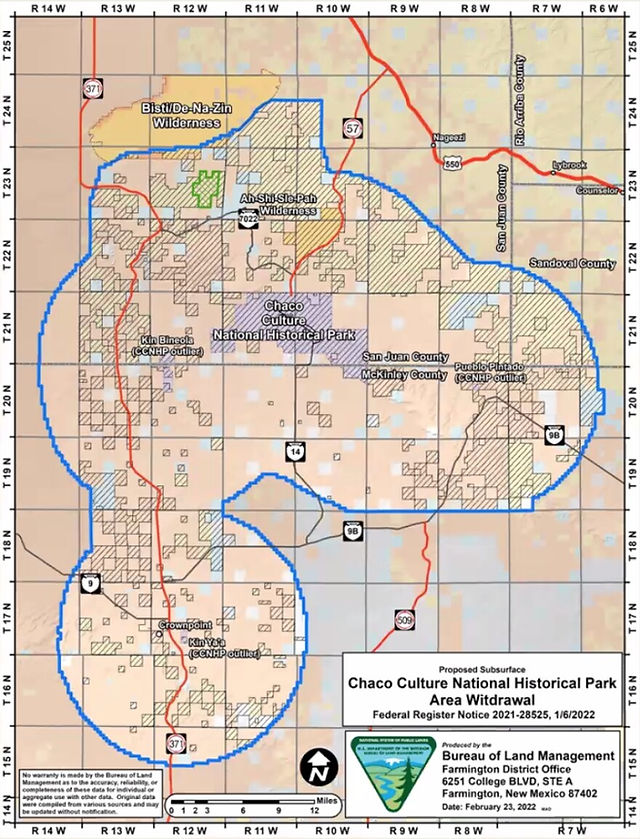
This is a Bureau of Land Management (BLM) map showing a proposed subsurface mineral withdrawal area
A Long Public Process Is Being Reconsidered in Two Weeks
The 2023 withdrawal followed a much longer federal review. The BLM held six public meetings and received more than 110,000 written and verbal comments. It also invited 24 Tribal Nations to participate in government to government consultation and met with Navajo allotment owners.
The current Draft Environmental Assessment comment period opened in July 2026 and closes July 29. The public has approximately two weeks to review and respond to a proposal that could reverse protections created through years of Tribal advocacy, consultation, public meetings, and federal analysis.
Indigenous advocates, conservation organizations, and New Mexico elected officials have criticized both the proposed revocation and the limited time available for public response. Critics argue that a compressed review cannot provide adequate time to examine a decision involving more than 336,000 acres and thousands of known cultural sites.
The concern is not simply that a federal policy may change. The concern is that decisions affecting an Indigenous cultural landscape are again moving forward through a process in which Tribal knowledge and meaningful public participation may not receive the time they require.
Public Comment Deadline: July 29, 2026
The Bureau of Land Management is accepting comments on whether to keep, reduce, or revoke the current protections surrounding Chaco Culture National Historical Park.
Comments must be submitted by July 29, 2026, at midnight Mountain Daylight Time.
The most effective comments identify missing information, factual errors, local or cultural knowledge, analytical gaps, reasonable alternatives, mitigation measures, or credible sources the BLM should consider.
Chaco Is Part of a Wider Change in Public Lands Policy
The Chaco proposal is unfolding during a broader shift in federal public lands management.
A 2025 analysis by the Center for American Progress identified Greater Chaco among several federal land protections being considered for reversal. The organization reported that the protected Chaco lands include thousands of known archaeological sites and more than 60,000 acres it classified among New Mexico’s highest value ecological lands.
In a separate 2026 action, the BLM began rewriting federal grazing regulations governing approximately 155 million acres across the West. An investigation by ProPublica and High Country News found that the proposed regulations would narrow who qualifies as an interested member of the public and reduce some opportunities to participate in or challenge grazing decisions.
The grazing regulations and the Chaco Environmental Assessment are separate federal actions. They should not be presented as the same proceeding. Together, however, they have raised concerns about how public and Tribal participation is being treated while federal land protections and management rules are rapidly reconsidered.
Protection Does Not Erase Every Competing Interest
The lands surrounding Chaco include a complicated pattern of federal, state, Tribal, private, and individually allotted mineral ownership. Families and communities may experience federal mineral policy differently depending on where they live, what rights they hold, and how development affects their health, income, land, water, and cultural responsibilities.
Protecting Chaco should not require pretending that every Indigenous person holds the same position or that the economic questions are simple. It does require recognizing that short administrative reviews cannot replace meaningful consultation, careful environmental analysis, or direct engagement with the communities most affected.
The 2023 withdrawal attempted to protect federal lands while preserving valid existing rights and excluding Tribal, state, private, and individually owned minerals from the order. Any reconsideration should accurately acknowledge those limits instead of suggesting that the existing protection ended all development or eliminated mineral rights throughout the region.
A Living Cultural Landscape Cannot Be Replaced
The lands surrounding Chaco are not empty spaces separating isolated archaeological sites. They are part of a connected cultural landscape shaped by generations of movement, ceremony, agriculture, trade, observation, memory, and community life.
Mineral development can extend far beyond the footprint of a single well, road, mine, or construction site. Industrial activity may alter viewsheds, night skies, air quality, water, wildlife movement, silence, access, and the physical relationships among cultural places.
Once those relationships are damaged, preserving a structure inside the park cannot restore the wider landscape around it.
The decision before the Department of the Interior is therefore larger than whether a regulatory boundary should be 10 miles, five miles, or removed. It concerns whether a protection established after decades of Tribal advocacy and supported by a century of bipartisan federal action will remain in place long enough to fulfill its stated purpose.
Public comments cannot replace Tribal consultation, and they are not counted as votes. They can place facts, cultural knowledge, analytical concerns, alternatives, and supporting documentation into the federal record before a final decision is made.
The public comment period closes July 29, 2026.
Plan your Visit
The Museum of Indigenous People is located at 147 North Arizona Avenue in Prescott, Arizona. The museum is open Monday through Saturday from 10:00 AM to 4:00 PM and is closed Sunday.

Sources
Bureau of Land Management, Evaluation of Potential Revocation of Chaco Withdrawal, Project Home https://eplanning.blm.gov/Project-Home/?id=D949F582-402D-F111-8341-001DD804183B
Bureau of Land Management, Submit a Public Comment https://eplanning.blm.gov/Participate-Now/?id=c90512e3-9480-f111-ab0f-001dd8084607&ppid=D949F582-402D-F111-8341-001DD804183B
United States Department of the Interior, Biden Harris Administration Protects Chaco Region, Tribal Cultural Sites from Development https://www.doi.gov/pressreleases/biden-harris-administration-protects-chaco-region-tribal-cultural-sites-development
Myrah Rafi’ah Beverly, The Pew Charitable Trusts, Federal Officials Can Honor Bipartisan Legacy of Greater Chaco Canyon Protections https://www.pew.org/en/research-and-analysis/articles/2026/03/12/federal-officials-can-honor-bipartisan-legacy-of-greater-chaco-canyon-protections
Joshua Bowling, Source New Mexico, New Mexico Advocates, Elected Officials Decry Federal Proposal to Curtail Chaco Canyon Protections https://sourcenm.com/2026/07/16/new-mexico-advocates-elected-officials-decry-federal-proposal-to-curtail-chaco-canyon-protections/
Mark Olalde and Jimmy Tobias, ProPublica and High Country News, The First Major Overhaul of Public Lands Grazing Regulations in a Generation Looks to Cut Out Public Involvement https://www.propublica.org/article/public-land-livestock-grazing-ranching-access
Mark Olalde and Jimmy Tobias, Source New Mexico, First Major Overhaul of Public Lands Grazing Rule in a Generation Looks to Cut Out the Public https://sourcenm.com/2026/07/13/first-major-overhaul-of-public-lands-grazing-rule-in-a-generation-looks-to-cut-out-the-public/
Drew McConville, Mariel Lutz, and Jenny Rowland Shea, Center for American Progress, The Trump Administration’s Expansive Push to Sell Out Public Lands to the Highest Bidder https://www.americanprogress.org/article/the-trump-administrations-expansive-push-to-sell-out-public-lands-to-the-highest-bidder/
New Mexico Wild, Protect Chaco Canyon https://nmwild.org/get-involved/sign-a-petition/protect-chaco-canyon/


